
Writing + photography / synthography = digital articulation by Shaun Lawton

The image above, to me, seems to represent perhaps some old, weathered piping deep underground, polished over time by running water beneath the topsoil, of what's left of some ancient ruins stemming from a subterranean Dwarven fortress. Perhaps it's the locking mechanism from an ancient gateway that once separated the cavernous realm of Dol Guldur from the rest of middle-Earth. Or maybe it's the remains of an old carburetor or the twisted wreckage of an ancient Aztec sculpture, it's difficult to pinpoint, exactly.
Now that we're deeply nesting within the continuum referred to as the 21st century, with its deep fake images receding into the darkest corners of a world wide web having taken on a life of its own, we are at least mentally equipped enough that we might recognize such an image as being itself fabricated from any variety of source images, rendering the final form of it in some manner to be counterfeit. Yet is not that the very precinct of art itself? If we assume that the word art may serve as the prefix for artifice and everything "artificial," then yes, but when we lean back and relax on the thought that beautiful artworks, from abstract sculptures carved out of marble to vivid paintings which reflect through light startling images to our eyes, we do get a sense of the inherit value in such contrivances. The image above should hardly be thought of as counterfeit, considering there remains no real precedent to which it stays attached, at least not one which could effectively substitute it.
From a teaspoon of spilled water on a countertop to the above image, I am here to trace the random lineage of appearance and its endless forms of similitude. Right off the bat I should introduce the above image as having resulted from my uploading a source image (the photograph I snapped of our kitchen counter top with some water spilled on it you see at the very bottom of this post) into an online free photo editor (befunky, my random choice of freely available and easy to use photo editors) and messing with the brightness / contrast / colors until achieving a darker and more interesting look. Then I uploaded that resulting image (a .jpg) into Deep Dream Generator and after pairing it with a separate image and making some minor adjustments, the image morphed into several different forms (see two of them below), made possible by my switching out some of the "style" images in DDG for experimentation, until it resulted in the top three iterations you see posted here.
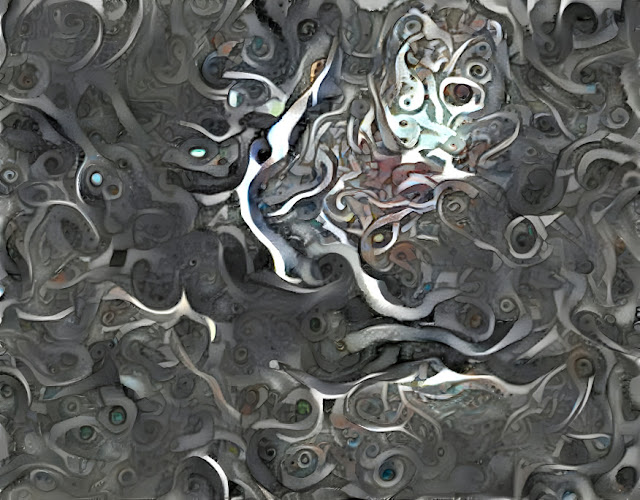
How are these variants of the original photo so alluring and interesting looking? My guess is that the source image must've been rich with visual cues and elements which lend themselves in highly volatile ways to the VQGAN + CLIP programs that enable AI algorithms to generate random iterations of two separate images fused together like this. There must be a plethora of scintillating color cues embedded within the light captured in the original photo reflecting from the gleaming countertop and off the curved surface of the water spill itself to produce a myriad different combinations of possibilities, resulting in an incalculable number of potential iterations, when you consider that there's no limit to the style images you might choose to utilize in crafting these deep dream generative artworks.
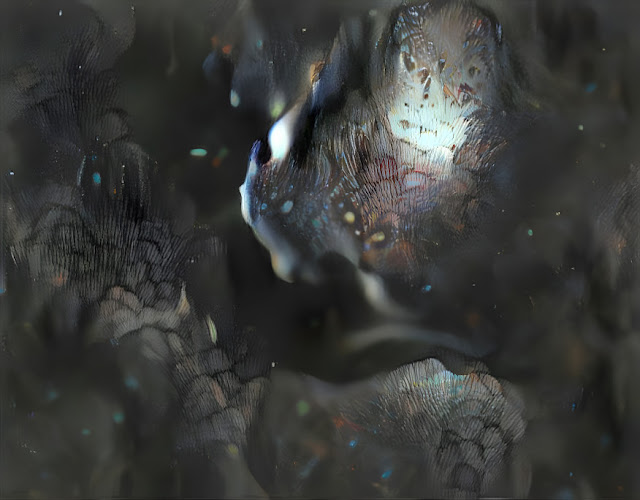
I love this last one a lot. There's something about the feathered, scaly textures that evoke not just obsidian refractions, but some sea-shell like aspects, reminiscent of Mother of Pearl, with some interesting suggestive effects blending in, as if it were at the bottom of a cavernous river, or perhaps somehow reflected off volcanic glass in a rainforest lagoon. These evocative hues and patterns which can be elicited from tweaking certain source images, taken with a smartphone, and then run through a basic online photo editor, before being paired with any given stylistic images, from analog to digital, to generate countless disparate iterations and variants, will continue to keep me occupied and inspired on my new mission to conjure as many of these Rorschachian portraits I can manage, which appear to reflect a cornucopia of pareidolia enhanced visual representations, that regardless of anyone else's opinions, I would nevertheless like to frame and call "art." Doubtless to say, the future remains such a gallery.

Here's the original source image, the snapshot taken from my iPhone of our modern kitchen counter top, with some water spilled on it. I remember intently focusing on the water spill from just the right angle, in order to capture the light from the ceiling in a certain way, so it would reflect off the misshapen puddle itself, to the point it somewhat resembled a dragon's head, as I imagined it after closely examining the snapshot. Pleased with the results, little did I know then that this singular image would evolve into the even more interesting and mystifying synthographic images depicted above, all of which resulted from my introduction to the world of VQGAN + CLIP art. The secret which makes this particular mundane photo so effective at having been decoded and rearranged, I would guess, lies in the very fact that it depicts water atop a bright, reflective counter top, with the added bonus of having light reflected off both the water and surface underneath. Art may be seen through a variety of different perspectives and lenses. It's been mentioned that it may be defined as shorthand for "artificial," but I've come to appreciate a better definition, that I learned from my brother, perhaps the most brilliant artist I've ever had the stunned pleasure to have known in my life. He told me that if art remains shorthand for anything, it should be articulation. As far as I'm concerned, that's the perfect definition for it.
This article was originally published in the blog EYESEAT, on February 8, 2022.
Return for more human interest
articles to appear in this daily digital digest

The Oscillating Oculus
brought to you by 


